
Slant Bed vs. Flat Bed CNC Lathes: Rigidity, Thermal Stability & ROI Comparison
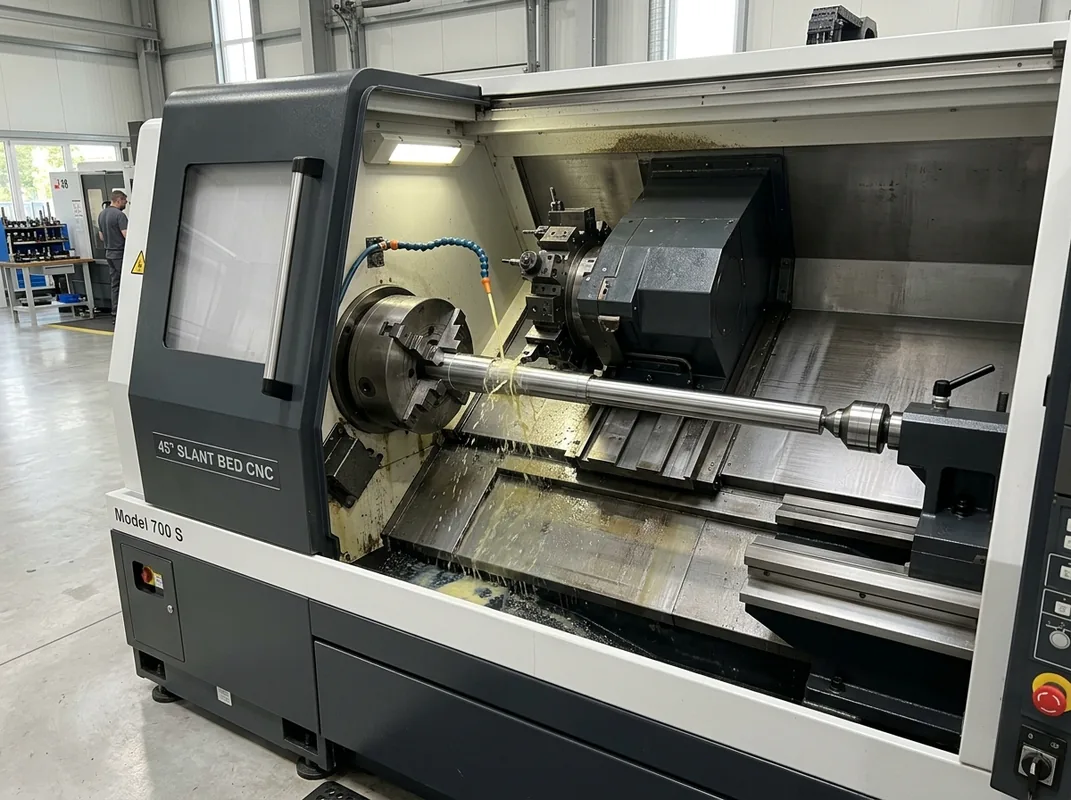
The Fundamental Structural Difference: 45° Incline vs. Horizontal Bed
When selecting a CNC lathe for your manufacturing facility, one of the first and most consequential decisions is choosing between a Slant Bed CNC Turning Center (such as the DONGS CNC TCK series) and a Flat Bed CNC Lathe (such as the CK series). While both machines perform single-point turning, threading, facing, and boring, their underlying kinematic architectures are engineered for fundamentally distinct production profiles.
A slant bed lathe places the cross-slide and turret on an inclined Meehanite casting plane—typically angled at 45 degrees or 30 degrees. In contrast, a flat bed lathe positions the saddle and cross-slide horizontally atop twin horizontal ways, echoing traditional engine lathe geometry with modern CNC ball screws and electric toolposts.
1. Cutting Force Vectors and Dynamic Rigidity
In metal cutting, cutting forces generate high thrust against the tool tip. On a flat bed lathe, the cutting force creates a cantilevering torque moment around the carriage guideways. Under aggressive roughing depths of cut, this lever arm can induce micro-vibrations and chatter.
On a 45° slant bed machine, the resultant cutting forces point directly downward into the thickest, heavily ribbed section of the monolithic cast bed foundation. This direct vector alignment significantly raises the machine's dynamic stiffness, enabling higher metal removal rates (MRR), superior surface finishes, and dramatically extended carbide insert tool life.
2. Chip Evacuation and Thermal Distortion
Hot steel chips carry up to 75% of the total cutting thermal energy. In high-volume production:
- On Flat Bed Lathes: Chips accumulate on the horizontal bed ways, requiring manual rake clearance. The direct thermal contact transfers heat into the machine bed over an 8-hour shift, causing bed thermal expansion and slight dimensional drift on tight-tolerance shafts.
- On Slant Bed Lathes: The steep 45° casting acts as a natural chute. Gravity causes incandescent chips to slide immediately into the bottom chip trough and onto the automated chip conveyor without settling on critical guideways or ballscrews.
3. Cycle Times & Automation Readiness
Slant bed lathes are built with high-speed servo indexing turrets (adjacent tool index under 0.2 seconds) and rapid traverse rates reaching 24–30 m/min. They are also effortlessly integrated with automatic bar feeders, hydraulic sub-spindles, and gantry robot loaders. A flat bed lathe, utilizing a 4-way electric toolpost with 6–10 m/min rapids, is ideal for low-to-medium batch work, large shaft turning, and maintenance tooling.
Quick Comparison Matrix
| Specification Feature | 45° Slant Bed Lathe (TCK Series) | Flat Bed CNC Lathe (CK Series) |
|---|---|---|
| Primary Production Profile | High-volume production, 24/7 cycles | Job shop, maintenance, long shafts, prototyping |
| Chip Disposal | Automatic drop-through to conveyor | Semi-manual chip clearance / horizontal pan |
| Turret Speed | 0.2s hydraulic / servo indexing (8-12 tools) | 1.5s - 2.5s electric 4-station toolpost |
| Capital Cost & ROI | Higher initial investment; fastest ROI on mass parts | Economical entry cost; maximum flexibility on varied parts |
Conclusion: Which Machine Delivers Higher Return for Your Shop?
If your daily work involves repeat automotive parts, hydraulic fittings, or complex parts requiring tight tolerances and automated bar feed operations, the DONGS CNC TCK50 or TCK52 will deliver vastly lower cost-per-part over its operational lifespan. If your shop handles variable repair jobs, long heavy shafts up to 3 meters, or occasional threading jobs on forged cylinders, a heavy-duty DONGS CNC CK6150 or CK6160 remains the most cost-effective capital investment.
Factory Technical Consultation
Planning to upgrade or purchase a CNC lathe or machining center?
Send your workpiece specifications or 2D/3D component drawings to our application engineering desk. We provide customized tooling layouts, cycle time analysis, and factory-direct CIF quotation within 24 hours.